
-
Call: +91 9028005102
-
Email: enquiry@medihse.in
How IRATA Standards Improve Safety in High-Risk Industrial Work
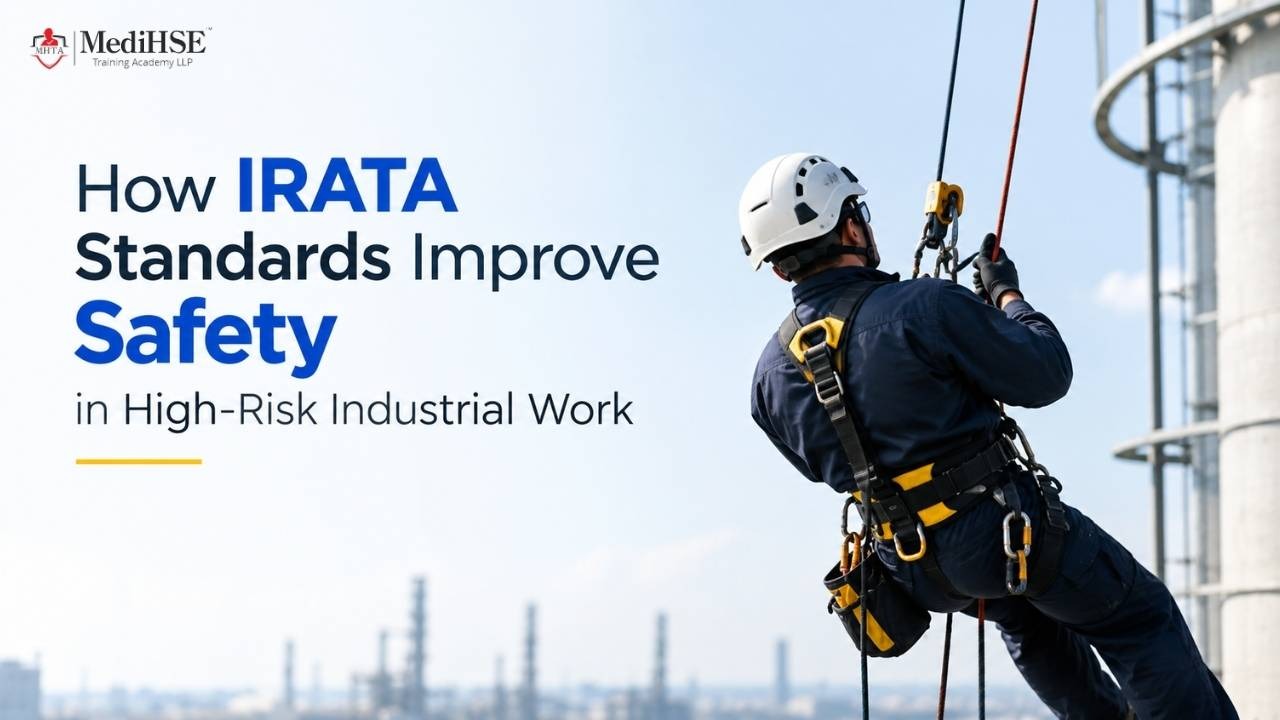
High-risk industrial activities often involve towers, chimneys, offshore structures, wind turbines and other difficult-to-access locations. Working at these heights requires more than basic precautions—it demands a structured approach to access, equipment, rescue and worker competency. Work at height training, combined with industrial HSE training and appropriate safety training courses in India, can help workers understand and implement recognised safety practices such as those promoted by IRATA.
What Is IRATA?
The Industrial Rope Access Trade Association (IRATA) has established an internationally recognised system for carrying out industrial rope access work.
Its approach focuses on competent personnel, appropriate equipment, systematic work procedures and effective rescue planning.
IRATA's training and operational framework uses a three-level competency structure. Technicians progressively develop skills in rope access techniques, equipment use, hazard awareness, rigging and rescue.
How Do IRATA Standards Improve Safety?
1. Competency-Based Training
A major safety principle is ensuring that personnel performing rope access work have appropriate training and practical competence.
Technicians learn controlled ascent and descent techniques, positioning, equipment inspection and emergency procedures.
This structured competency model complements work at height training in India, particularly for professionals working in challenging industrial environments.
2. Proper Equipment Management
Rope access systems rely on specialised equipment such as harnesses, ropes, connectors, descenders, ascenders and fall-protection devices.
Equipment must be selected according to the task, inspected and maintained properly.
Understanding equipment limitations is essential because incorrect selection, improper installation or damage can compromise the entire access system.
3. Redundancy and Two-Point Protection
Industrial rope access generally uses a two-rope system, consisting of a working line and a safety line.
This provides redundancy and reduces dependence on a single rope or connection point.
Technicians also use appropriate connectors, backup devices and anchorage systems to maintain protection throughout the work activity.
4. Rescue Planning
An effective rescue plan is a critical component of rope access operations. Workers need to be prepared for scenarios such as suspension incidents, equipment failure or medical emergencies at height.
Rescue procedures should be practical, site-specific and supported by trained personnel and suitable rescue equipment.
5. Stronger Risk Management
RATA's systematic approach encourages organisations to identify hazards, assess risks and establish appropriate control measures before work begins. Factors such as falling objects, rope damage, weather conditions, anchor failure and interaction with other work activities must be considered.
Building Safer High-Risk Workplaces
IRATA principles demonstrate that safe rope access depends on competency, equipment integrity, redundancy, supervision and emergency preparedness.
Organisations can strengthen these capabilities through professional work at height training in India, designed around the hazards of high-risk industrial work.
these essential process-safety capabilities.
Also read: Work at Height Safety: How Rope Access Training Reduces Workplace Risks